Building an AI-Powered Product Workflow in 2026

An "AI-powered product workflow" sounds like a thing vendors sell you. In practice it's a set of specific habits: places in your weekly work where you substitute AI assistance for manual effort, with clear handoff points where human judgment takes over.
This guide is about building one that actually works — not the theoretical version, but the version that survives contact with a real product team with real deadlines.
The Workflow Map
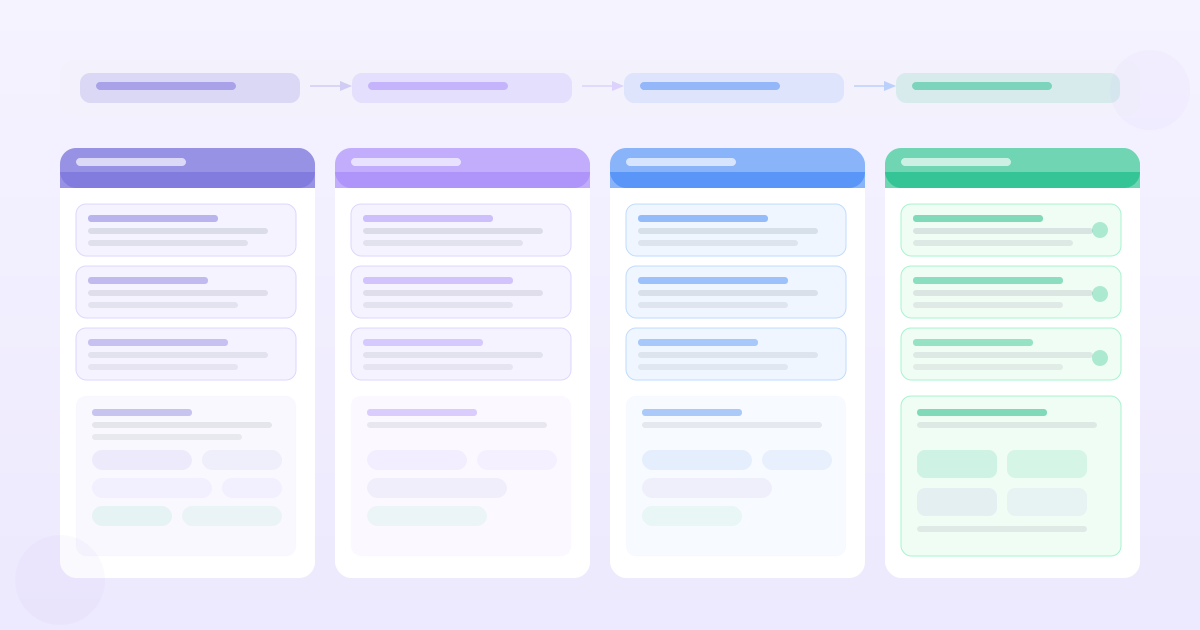
A typical product workflow has six phases where AI can add leverage:
- 1Customer feedback collection → AI for aggregation and initial tagging
- 2Research synthesis → AI for theme extraction and quote surfacing
- 3Opportunity framing → Human + AI for problem statement drafting
- 4PRD writing → AI for first draft, human for accuracy and judgment
- 5Backlog management → AI for duplicate detection and scoring
- 6Stakeholder communication → AI for drafting, human for relationship management
The handoff pattern is consistent: AI handles the mechanical work within each phase, human handles the judgment calls at transitions between phases.
Phase 1: Customer Feedback Collection
The foundation of good product work is a reliable evidence base. AI can help you build one.
What to collect: Interview transcripts, survey responses, support tickets, NPS verbatims, Slack threads where customers or users are discussing the product, sales call notes.
What AI does here: Aggregation and initial tagging. If you're using a tool like PMRead or Dovetail, feedback gets categorised by topic (search, onboarding, pricing, export) automatically. You're not reading every item — you're reviewing category summaries and drilling into specifics when something's important.
The habit: Set a weekly 30-minute block to review what came in and flag anything that changes your current understanding of the top problems. Don't try to act on every piece of feedback — you're looking for pattern shifts.
Phase 2: Research Synthesis
Synthesis is where most teams lose time. Interview notes pile up unread. Survey data goes stale in a spreadsheet. The PMs who do good synthesis have a systematic approach; the ones who don't end up writing from memory.
What AI does here: Theme extraction, frequency analysis, and surfacing representative quotes for each theme. You feed it the raw data; it gives you structure.
The most useful AI synthesis output isn't a summary — it's a set of findable, quotable evidence anchors. When you write a PRD requirement, you should be able to link it to a specific customer quote. AI synthesis that doesn't produce this linkage has given you conclusions without sources.
The habit: After every research round (monthly, quarterly, or after a discovery sprint), run a synthesis pass before the insights are stale. The sooner after collection, the more context you have to interpret the AI's output.
Phase 3: Opportunity Framing
This is the phase where human judgment matters most and where AI is most useful as a thinking partner rather than a generator.
What you're doing here: Translating research findings into a clear opportunity statement. "The research shows X. This suggests that Y is the opportunity. We'd know we've addressed it if Z."
What AI does here: Drafting the opportunity statement from your research, then probing it. "Here are the top themes from my research. Draft an opportunity statement." Then: "What assumptions is this opportunity statement making? What evidence would challenge it?"
AI is good at probing your reasoning for holes. It's not a replacement for the strategic judgment about whether this opportunity is worth pursuing, but it catches logical gaps before you've committed to a solution.
The habit: Write your opportunity framing before writing any solution requirements. AI helps make this faster, not skippable.
Phase 4: PRD Writing
This is where AI adds the most obvious time savings.
What AI does here: Generates the first draft from your problem framing and research inputs. Covers user stories, acceptance criteria, edge cases, and constraints. In a purpose-built tool like PMRead, every generated requirement links back to the customer evidence that produced it.
What you do: Edit for accuracy (remove requirements that don't match your actual research), add strategic framing (this is why we're doing this now), write the metrics (the only section AI consistently gets wrong), and add the prioritisation call.
The metric section is worth calling out specifically. AI generates plausible metrics that often aren't the ones your team has agreed to track or that don't align with your current company OKRs. Write these yourself, every time.
The habit: Never send an AI-generated PRD to engineering without an editing pass where you've verified every major requirement against your research. A 20-minute review saves days of building the wrong thing.
Phase 5: Backlog Management
Backlogs become unmanageable without active maintenance. AI helps with two specific problems: duplication and stale items.
Duplicate detection: AI can scan a backlog and identify items that are describing the same underlying issue with different wording. In a backlog of 200+ items this is a significant time saver.
Scoring against criteria: AI can take a feature request and score it against a consistent rubric (RICE, ICE, customer segment, strategic alignment) faster than you can do it manually. You set the rubric; AI applies it consistently.
What you still do: Decide what to cut. Prioritisation is ultimately a political act — it's a statement about what matters enough to take limited engineering capacity away from something else. AI can tell you the RICE score. Only you can make the commitment.
The habit: Monthly backlog grooming with an AI pre-pass for duplicates and scoring. Then a 60-minute human session to validate AI scoring and make the cuts.
Phase 6: Stakeholder Communication
Writing updates, presenting to executives, preparing for sprint reviews — this is time-consuming and pattern-heavy.
What AI does here: First drafts of stakeholder updates, release notes, exec summaries, and decision memos. These follow reliable structures and don't require the deep context that requirements writing does.
What you do: Personalise for the audience, add the subtext (what you're worried about, what decision you need, what the political context is), and make sure the strategic framing reflects actual company priorities rather than generic PM language.
The habit: Keep a stakeholder update template that you feed into AI with a bullet list of facts for each cycle. The structure stays consistent; the content regenerates each time.
Making It Stick: The Anti-Patterns
Three patterns kill AI workflow adoption:
Too many tools. If your AI workflow requires six different tools and five context switches per day, you won't use it. Start with two tools (one for feedback analysis, one for PRD writing) and only add more when you've hit a genuine gap.
Treating AI output as final. The teams that get burned by AI in product workflows are the ones who skip editing. An AI-generated PRD that ships to engineering unreviewed is a liability, not a productivity gain.
Using AI to avoid doing research. AI can synthesise research. It can't replace it. The "I'll just ask AI what users want" shortcut produces requirements based on what AI thinks users like yours want, which is not the same as what your users actually want.
A Week in an AI-Powered PM Workflow
Here's what the weekly rhythm looks like in practice:
Monday: Review AI-tagged feedback digest from the week. Flag two or three items to follow up on.
Tuesday–Wednesday: Deep work — customer interviews, cross-functional meetings, strategy work. No AI here; these require presence.
Thursday: Use AI to run synthesis on any new research from the week. Draft opportunity framing for the next sprint.
Friday: PRD work if needed — AI first draft, human editing pass. Prep stakeholder update with AI draft, personalise manually.
Total active AI time: roughly 90 minutes per week. Time saved: 4–6 hours on writing and synthesis.
The AI-powered product workflow isn't a new way of doing product management — it's the same discipline with faster mechanical execution. The judgment, the research, the strategy, and the relationships stay human. The first drafts, the synthesis, and the pattern-matching get assistance.
Want PRDs grounded in your actual customer data?
PMRead ingests your interviews, Slack threads, and feedback files — and generates PRDs backed by real evidence, not guesses.
Try PMRead free →