AI for Qualitative Research: Does It Actually Work?

The promise is appealing: feed your user interviews into an AI tool and get structured insights back in minutes instead of spending days coding transcripts. But PMs and UX researchers who've tried it have a mixed experience. Sometimes the output is genuinely useful. Sometimes it's plausible-sounding summaries that don't capture what the interviews actually said.
This is an honest evaluation of where AI qualitative research analysis works, where it fails, and how to get the most out of it without fooling yourself.
What "Qualitative Research Analysis" Actually Involves
Before evaluating AI's performance, it helps to be precise about what the task involves. Qualitative analysis is not summarisation — it's a process of:
- 1Coding — assigning labels to pieces of data (this quote is about "onboarding friction"; this one is about "search quality")
- 2Patterning — identifying which codes appear repeatedly and which appear in combination
- 3Interpretation — making sense of patterns: what do they mean about user behaviour, mental models, or unmet needs?
- 4Theory-building — sometimes, constructing a richer understanding of how users think about a problem domain
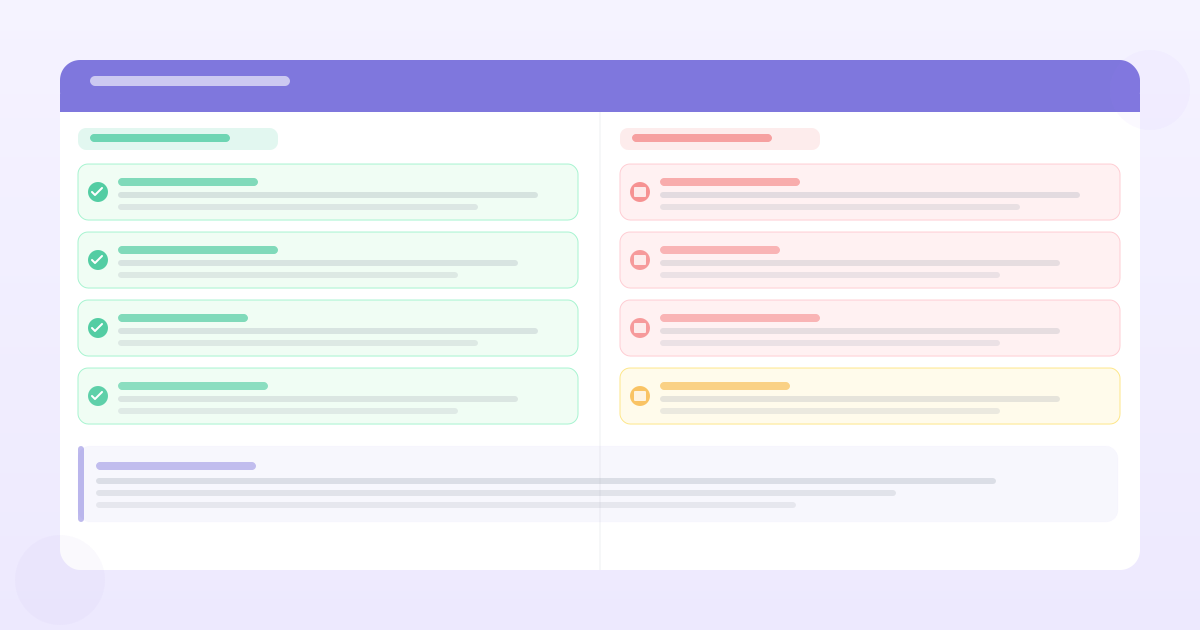
AI tools in 2026 can handle steps 1 and 2 reasonably well. Step 3 — interpretation — requires context about your product, your users, and your current product strategy that AI typically doesn't have. Step 4 is not something AI does reliably.
Where AI Works Well
Thematic coding at scale
If you have 30 interview transcripts and need to identify the 10 most commonly discussed topics, AI can do this faster and more consistently than a human coder. It doesn't get tired. It doesn't drift in how it applies codes over a long session. It doesn't favour topics that came up in the last interview it read.
This is the strongest AI use case for qualitative research. The output is a frequency-labelled topic list — not insights, but the raw material for insights.
Surfacing representative quotes
Ask an AI to find the three quotes that best illustrate a given theme and it will find them. Ask it to find the quote that most clearly expresses a specific user frustration and it will surface it. This is far faster than manually searching through dozens of transcripts.
The caveat: "representative" is doing a lot of work here. The quote AI selects is statistically representative, not necessarily the most illuminating or the most nuanced. Always read the surrounding context.
First-pass tagging for a research repository
If you maintain a research repository (Dovetail, Notion, Airtable), AI can handle the mechanical tagging work: which clips relate to onboarding, which relate to pricing, which relate to a specific user segment. This doesn't require interpretation — it's pattern matching.
Sentiment scoring
At the transcript level, AI is accurate at distinguishing broadly positive from broadly negative sentiment. At the utterance level (this specific sentence expresses frustration), accuracy is decent but not reliable. Use sentiment as a directional indicator, not a precise measurement.
Cross-study pattern detection
If you have 6 months of interview transcripts and you want to know whether a particular theme has become more or less common over time, AI can track this across your corpus in a way that would take a human researcher hours.
Where AI Fails Qualitative Research
Missing what's unsaid
Qualitative research is valuable precisely because it surfaces what users don't say in surveys — the hesitation in their voice, the workaround they've developed that they didn't mention because it seemed too obvious, the frustration they've normalised. AI only has the text. It cannot notice what's absent.
A user who says "I just export it to Excel and finish it there" is describing a workflow workaround. The significance — that your product's native functionality is insufficient for a key use case — requires interpretation. AI can identify the statement; it typically won't infer the significance without being prompted.
Conflating frequency with importance
AI analysis produces frequency counts: "search was mentioned in 14 of 20 interviews." But a product problem mentioned by one enterprise customer who accounts for 40% of your ARR matters more than a minor annoyance mentioned by 14 SMB users. AI doesn't know your customer economics.
Interpreting cultural or domain-specific language
If your users work in a specialised field (finance, healthcare, legal, engineering), their language carries domain-specific meaning that AI may miss or misinterpret. "This doesn't scale" means something very different said by an engineer vs a sales manager. AI language models have general training; your users may speak a professional dialect.
Generating insight from contradiction
Some of the most valuable qualitative findings come from apparent contradictions — users who say one thing and do another, or who express competing needs within a single interview. AI tends to resolve contradictions by averaging them rather than flagging them as analytically significant.
Being fooled by articulate users
AI analysis tends to over-index on content from articulate users who express themselves clearly. Users who struggle to articulate their experience often have equally valid and often more commercially significant problems — but they're harder to code because the language is vague.
A Practical Hybrid Workflow
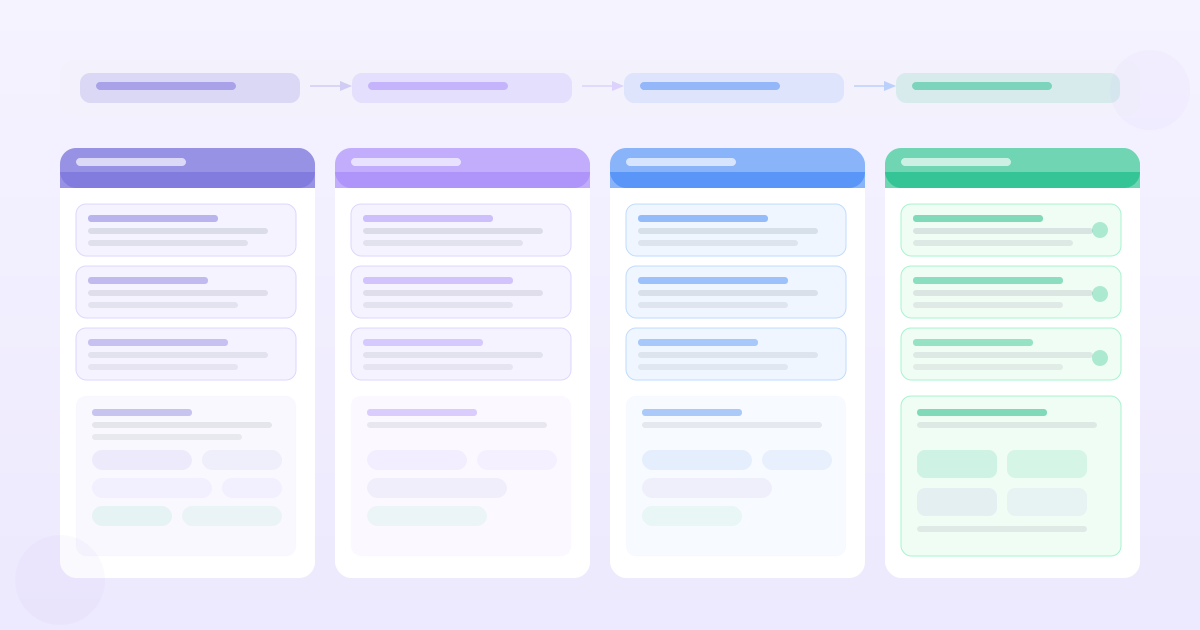
The best qualitative research workflows in 2026 use AI for the mechanical stages and humans for the interpretive ones.
Stage 1: AI pre-processing (30 minutes per study)
- Feed transcripts to AI analysis tool
- Get theme/code frequency list
- Get representative quotes per theme
- Get sentiment breakdown by interview
Stage 2: Human review of AI output (60–90 minutes)
- Validate that AI codes match your actual research questions
- Identify codes AI created that don't reflect meaningful distinctions in your context
- Check whether AI has missed codes that you know from domain knowledge should be present
- Pull 2–3 additional quotes per theme that the AI missed but you notice on review
Stage 3: Human interpretation (the non-automatable part)
- What do the patterns mean for this specific product, user segment, and moment in time?
- What assumptions are embedded in how users describe the problem?
- What would a user who experienced this problem differently look like — and why don't they appear in the data?
- What are the implications for prioritisation?
Stage 4: Documentation with AI assist
- Write up findings with AI drafting the structure
- Include specific quotes for each finding (AI surfaced these; you validated them)
- Write the implications section yourself
Evaluating AI Qualitative Research Tools
When choosing a qualitative analysis tool, the questions that matter:
Does it cite sources? Any AI analysis tool worth using should link every finding back to a specific quote in the original data. If it gives you insights without sources, you can't verify or challenge anything.
Can it handle your input formats? Does it handle video transcripts, Zoom files, audio transcriptions, written interview notes, and survey open-ends equally? Or is it specialised for one format?
Does it understand research structure? An interview has structure — warmup, problem exploration, solution reaction, wrap-up. AI tools that are interview-aware produce better analysis than tools that treat the transcript as flat text.
How does it handle multiple languages? If your users aren't native English speakers and your transcripts are in multiple languages, does the tool handle this accurately?
What happens with long transcripts? A 60-minute interview transcript can be 8,000–10,000 words. Some tools struggle at this length; others handle it gracefully.
The Honest Bottom Line
AI qualitative research analysis is a real productivity improvement for the mechanical parts of the work: coding, frequency counting, quote retrieval, cross-study pattern detection. For a PM doing ad hoc research without a dedicated researcher, it's a meaningful unlock.
It is not a replacement for the interpretive work that makes qualitative research valuable. The insight that changes a product direction — the one that reframes how you think about a problem — almost never comes from a frequency count. It comes from a researcher who noticed something unexpected, followed up, and understood what they were seeing.
Use AI to get to the data faster. Use your judgment to decide what it means.
Want PRDs grounded in your actual customer data?
PMRead ingests your interviews, Slack threads, and feedback files — and generates PRDs backed by real evidence, not guesses.
Try PMRead free →