The Product Launch Checklist That Prevents the Most Common Ship-Day Failures

Most product launches don't fail because the feature was bad.
They fail because analytics wasn't instrumented before the flag was flipped. Because support didn't know the feature existed until users started asking about it. Because the email went out before the feature was actually deployed. Because nobody had an explicit plan for what to do if something went wrong.
A product launch checklist isn't a bureaucratic hurdle — it's the record of everything that's gone wrong in the past, codified so it doesn't happen again.
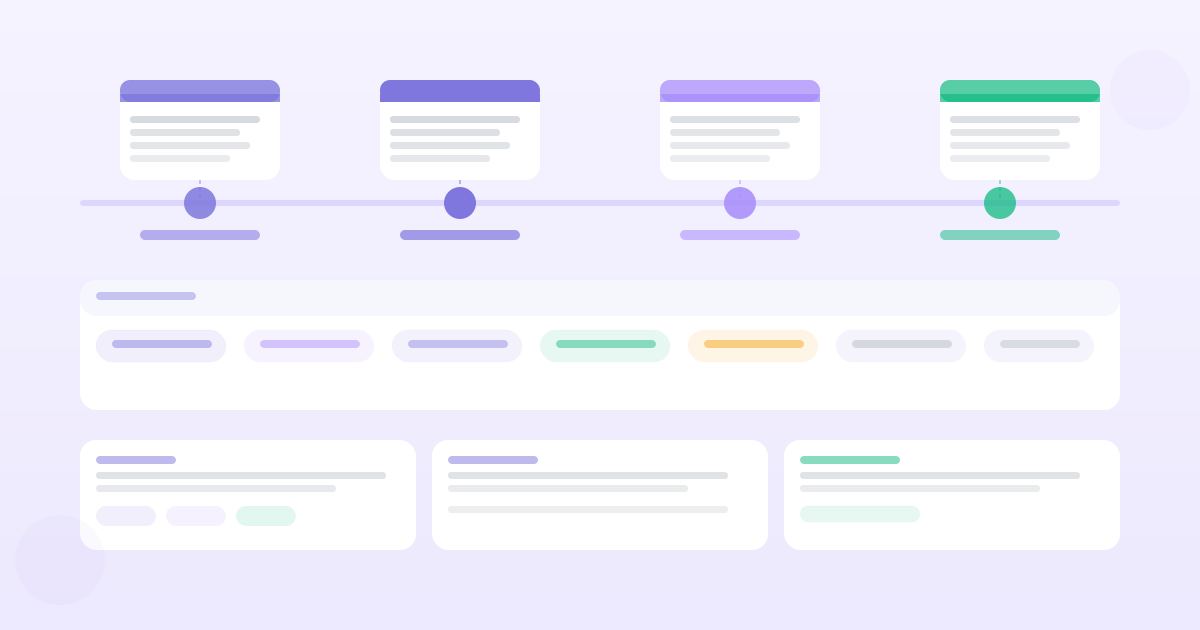
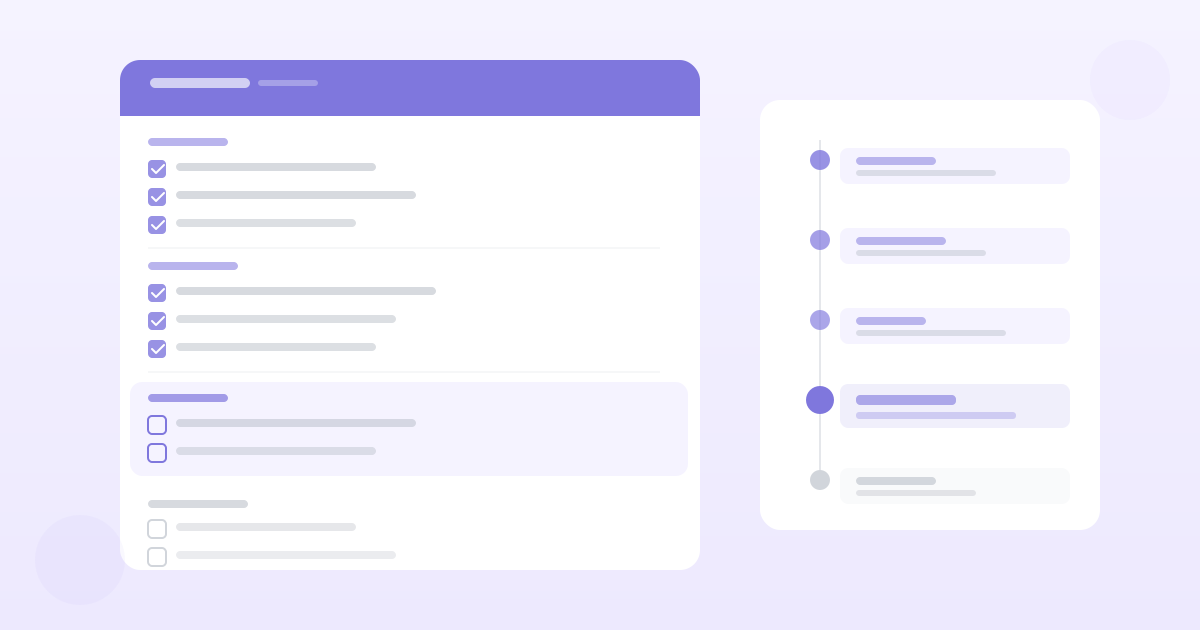
Here's the full pre-launch sequence, from 4 weeks out to post-ship.
Four Weeks Before Launch
Define your success metrics — before you're in the building.
Write down: what would make this launch a success at 30 days? At 90 days? Activation rate? Feature adoption? Retention impact? Revenue from the feature? If you can't answer this before you ship, you won't be able to evaluate whether the launch worked.
Confirm your go-to-market plan.
Who are you launching to first? Your full user base? A segment? Existing paying customers first, free users second? The answer affects every other launch decision. A go-to-market template should cover: target audience, launch sequence, messaging by segment, and which channels you're using for each.
Write the announcement draft.
Writing the launch copy four weeks before launch forces you to articulate what the feature does and why users should care. If you can't write a clear announcement without excessive caveats, the feature probably isn't ready to ship.
Identify the risk scenarios.
What could go wrong? Performance under load, unexpected edge cases, data loss for specific account configurations, rate limiting on a third-party API? For each scenario: what's the mitigation? Who makes the call to roll back?
Two Weeks Before Launch
Instrument all analytics events.
Every interaction you need to measure — impressions, clicks, activations, conversions — should be tracked before launch day. Launching without analytics means spending your first month post-launch with no data to learn from.
Standard events to instrument for any feature launch: feature_impression (user saw the feature), feature_engaged (user interacted), feature_activated (user completed the core action), feature_converted (downstream outcome).
Brief customer support.
Support needs: what the feature does, what it doesn't do, common user questions, known limitations, how to reproduce and report bugs, and who to escalate to. Support should have this before the feature goes to users — not after.
Update documentation and help center.
Users who get stuck go to documentation. If the docs don't cover the feature, they open a support ticket. Update docs before launch, not after the first support spike.
Run a bug bash.
One focused session — 2 hours, the full cross-functional team — trying to break the feature. Use it specifically, targeting edge cases: empty states, permission combinations, mobile, slow network, concurrent use. The bugs found in a bug bash take an hour to fix. The bugs found by users after launch take a week of incident response.
One Week Before Launch
Final stakeholder review.
A 30-minute walkthrough with sales, support, marketing, and any executive stakeholder who'll be asked about the launch. Not for approval — for awareness. The question to answer: does anyone have new information that should change the launch plan?
Set up your monitoring.
Error rates, p95 latency, database load, third-party API response times — all should have alerting configured before launch. Define your escalation path: who gets paged if error rate exceeds X%? Who makes the rollback decision?
Confirm the rollout strategy.
Full release to 100% of users on day one? Percentage rollout starting at 10%? Feature flag by customer segment? Dark launch (fully deployed, not visible to users) for another week? The rollout strategy should match your confidence level and your ability to respond to incidents.
Schedule the post-launch review.
Put the 30-day review on the calendar now. It won't happen if you schedule it after launch day — you'll be too deep in the next feature.
Launch Day
Deploy during low-traffic hours.
For most B2B products, mid-morning weekday traffic is highest. Deploy Tuesday evening or Wednesday morning before the peak. For consumer products, check your traffic data. Never deploy right before a weekend if you want to be able to respond.
Verify in production before announcing.
Go through the full happy path yourself, in the production environment, on the production account. Not staging. Not your internal test account with special permissions. The account a new user would have. Then verify one edge case.
Send announcements in sequence.
Changelog → existing users → social → press (if applicable). Don't announce externally before your existing users know.
Monitor for the first two hours.
The PM and at least one engineer should be watching error rates, support volume, and primary metrics for the first two hours post-launch. If something looks wrong, you have the context to act immediately.
First 30 Days Post-Launch
Track adoption by cohort.
Overall adoption rates hide the story. Break it down: what's adoption rate for users who signed up after launch vs. before? What's the activation rate for users who saw the feature on day 1 vs. day 7?
Run a qualitative sweep at week 2.
Five quick user interviews with people who used the feature and five with people who didn't. The non-adopters often tell you more: "I didn't even know that button did that" or "I tried it once but it didn't work for my workflow" — these are findings, not excuses.
Hold the 30-day review.
Compare against the success metrics you defined four weeks before launch. What was the actual activation rate? What moved downstream? What didn't? What would you do differently? Document this — your future self will use it for the next launch.
The GTM Checklist Summary
| Phase | Check |
|---|---|
| 4 weeks | Success metrics defined, GTM plan, announcement draft, risk register |
| 2 weeks | Analytics instrumented, support briefed, docs updated, bug bash complete |
| 1 week | Stakeholder review, monitoring set up, rollout strategy confirmed, post-launch review scheduled |
| Launch day | Low-traffic deploy, production verification, sequenced announcements, active monitoring |
| 30 days | Cohort analysis, qualitative sweep, review against success metrics |
A checklist only helps if it's honest. Add the checks your team consistently skips — those are your most important checks.
Download the free Go-to-Market Template to build your launch plan from the framework above.
Want PRDs grounded in your actual customer data?
PMRead ingests your interviews, Slack threads, and feedback files — and generates PRDs backed by real evidence, not guesses.
Try PMRead free →