TAM SAM SOM Explained: How to Size a Market Without Making Up Numbers

Every pitch deck has a slide with three numbers: Total Addressable Market, Serviceable Addressable Market, Serviceable Obtainable Market.
Most of those numbers are made up.
Not maliciously — the PM or founder finds a market research report, divides by something that sounds reasonable, and arrives at a TAM that supports the narrative. Investors know this, which is why they're skeptical of TAM slides, and why the best ones ask how you calculated the number, not what the number is.
Here's how to do TAM SAM SOM analysis honestly — and what it's actually useful for.
What Each Number Means
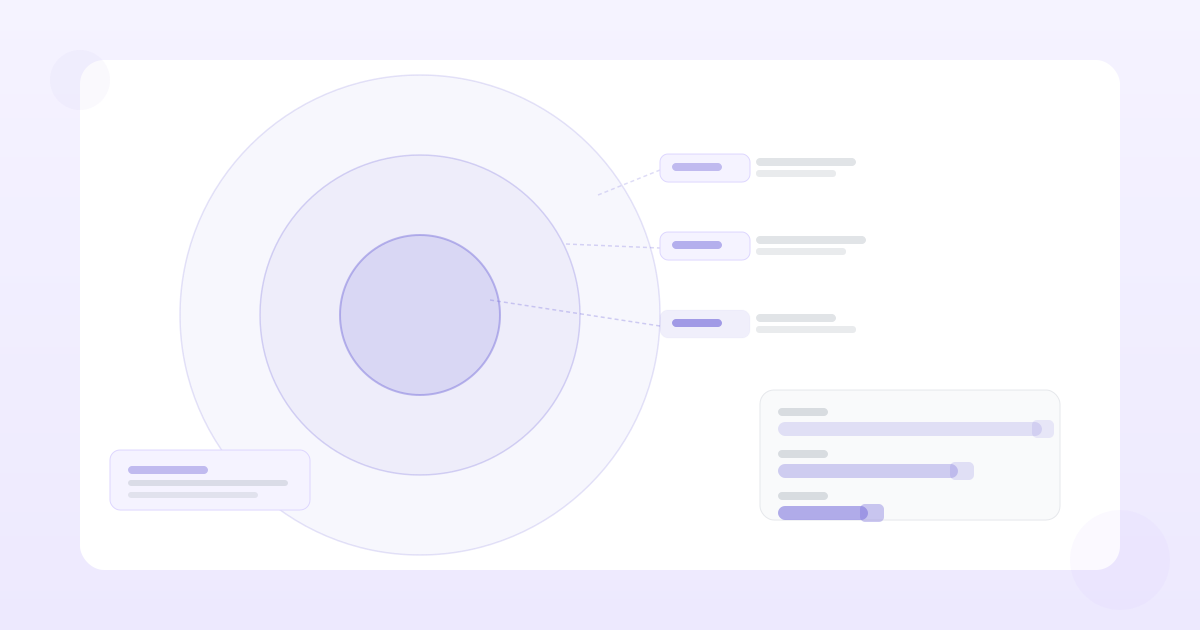
TAM — Total Addressable Market: The total revenue opportunity if you captured 100% of the market, with no competition, and sold to every possible customer. This is a theoretical ceiling, not a real target.
SAM — Serviceable Addressable Market: The portion of TAM that your product can actually serve, given your current capabilities, geography, language, integrations, and product scope. If your product only works in English and you're based in India, your SAM excludes non-English-speaking markets regardless of their TAM.
SOM — Serviceable Obtainable Market: The portion of SAM you can realistically win in the next 3–5 years, given your go-to-market, sales capacity, competitive landscape, and current traction. This is the number you're actually planning against.
The relationship is always TAM ≥ SAM ≥ SOM, and each step down involves real constraints — not arbitrary percentages.
The Two Approaches to Market Sizing
Top-down sizing
Start from a large number (a market research report or industry statistic) and work down.
"The global project management software market is $6.6B. Product management tools represent approximately 15% of that. India-focused PM tools represent approximately 8% of that. That gives us a SAM of ~$79M."
The problem with top-down sizing: The large number at the top is often wrong, the percentages are guesses, and the result can be whatever you want it to be depending on which fractions you apply. Sophisticated investors don't trust it without validation.
Top-down sizing is useful for a directional sense of market scale. It's not useful as a standalone analysis.
Bottom-up sizing
Start from unit economics and build up.
"There are approximately 2.4 million product managers in India and Southeast Asia (based on LinkedIn job title counts). Of those, approximately 30% work at companies large enough to have dedicated PM tooling budgets ($500+/year). That's 720,000 potential users. At ₹1,699/month, the annual revenue from fully converting that segment would be ₹14,600 crore (~$1.7B). That's our SAM."
Why bottom-up is more useful: Every assumption is explicit and can be challenged. You can update individual numbers as you get better data. Investors can follow the logic.
Do both. If your top-down and bottom-up estimates are within the same order of magnitude, you have more confidence in the number. If they differ by 10x, you're missing something.
A Worked Example: B2B SaaS PM Tool
Here's how to structure a TAM SAM SOM calculation from scratch:
Step 1: Define your unit
What are you selling, to whom, at what price? "Monthly subscriptions to individual product managers at companies with 5–500 employees at ₹1,699/month."
Step 2: Count the universe (TAM)
LinkedIn shows ~800,000 people with "Product Manager" in their title across India. Add adjacent roles who might also be customers (founders doing PM work, growth roles): ~1.2M total. Annual value per user: ₹20,388. TAM = ₹24,000 crore (~$2.8B).
Step 3: Apply real constraints (SAM)
Your product requires English. It requires a company with a digital product team. It requires someone who writes PRDs — not all PMs do. Realistic filter: 35% of the TAM. SAM = ₹8,400 crore (~$1B).
Step 4: Apply execution constraints (SOM)
You're a team of 4. You can reach users through content marketing and word of mouth initially. In year 3, with realistic growth, you can realistically hold 0.5% of SAM. SOM = ₹42 crore (~$5M).
The SOM should feel achievable — not aspirational. The number to optimize and defend is the SOM, not the TAM.
What Market Sizing Is Actually For
TAM is a story about the size of the opportunity — it's for investors and strategic planning.
SAM is a boundary — it tells you which customers you're actually building for and which you're not (yet).
SOM is a plan — it should connect directly to your headcount, your go-to-market investment, and your revenue forecast.
The most common mistake is using TAM in contexts where SAM is the right number. "We're going after a $3B market" sounds impressive and is completely useless for a team deciding whether to hire a second salesperson.
Common TAM SAM SOM Mistakes
Cherry-picking a large TAM from a broad industry. "The global software market is $800B" is not a TAM for your product — it's a distraction. Your TAM should be specific to your actual product category.
Percentage-of-market SOM without reasoning. "We'll capture 1% of the market" means nothing. 1% based on what? Your current growth rate? A sales capacity model? Historical comparable? Without reasoning, it's an arbitrary number that doesn't help planning.
Forgetting constraints that shrink SAM. Geographic constraints, language constraints, integration requirements, minimum company size — all of these shrink your SAM from your TAM. List them explicitly.
Using TAM as a target. TAM is not your revenue target. It's not even close to your revenue target. The companies that "own" a market category rarely have more than 20–30% of it.
When Market Sizing Changes Your Product Decisions
Market sizing is most useful when it changes a decision. Typical cases:
- Segment prioritisation. If your SAM for enterprise customers is 10x your SAM for SMB, but your current motion is entirely SMB-focused, that's a strategic conversation you should have.
- Geographic expansion. If your SOM analysis shows you've saturated your home market at current growth rates, it tells you where to expand — and which expansion has the biggest SAM relative to your current capabilities.
- Build vs. partner decisions. If a customer segment has large TAM but would require building localisation, compliance infrastructure, and a new sales motion to serve them, the SAM calculation informs whether it's worth investing.
Market sizing is a thinking tool, not a pitch tool. Build it so it helps you make decisions — and the pitch will follow.
Want PRDs grounded in your actual customer data?
PMRead ingests your interviews, Slack threads, and feedback files — and generates PRDs backed by real evidence, not guesses.
Try PMRead free →