How to Run a Customer Discovery Sprint in Five Days

Most product discovery happens in slow motion.
A customer complaint surfaces in a support ticket. The PM files it mentally. Three months later, another one appears. Six months later, there's a feature request in the product board. A year after the first signal, someone decides to investigate.
A customer discovery sprint compresses that slow accumulation into one focused week. Five days, structured deliberately, produces enough evidence to make a real decision about what to build next.
Here's the exact structure.
What a Discovery Sprint Is (and Isn't)
A discovery sprint is a time-boxed period of customer research focused on a specific problem space. The output is not a feature — it's a decision: whether to pursue this problem, what form a solution might take, and which assumptions need to be validated before you commit engineering time.
It is not a design sprint. You're not prototyping or testing designs. You're in the problem space, not the solution space.
It is not a roadmap exercise. You might not add anything to the roadmap — a discovery sprint that reveals you're solving the wrong problem is just as valuable as one that confirms you should build something.
A good discovery sprint answers: Is this problem real? How frequent and acute is it for our target customer? What workarounds do people use today? What would a solution need to do to replace those workarounds?
Who Should Run It
One or two people at most. The PM and a UX researcher if you have one; the PM and a designer if you don't. Engineering involvement is valuable — have an engineer observe at least two calls — but too many interviewers changes the dynamic of customer conversations.
The PM should conduct at least five calls personally. Reading someone else's synthesis of a customer conversation is not the same as hearing the hesitation in a customer's voice when they describe their current workaround.
Day-by-Day Structure
Day 1: Define the sprint question
Write one question that the sprint is trying to answer. Not a topic — a specific question.
Too broad: "What do users want from the notifications feature?"
Specific enough: "Are users missing important changes in their projects because they're not returning to the tool between weekly planning sessions — and if so, what's causing the gap?"
The sprint question determines who you recruit, what you ask, and what counts as a useful finding.
Spend day 1 writing the sprint question, identifying who to recruit (aim for 8–10 users in the target segment), and preparing the interview guide.
Day 2: Conduct interviews (part 1)
Four interviews, 30–45 minutes each.
Run them back to back with 15-minute breaks for notes. If you space them over a week, you lose the comparative edge — insights from interview 1 should be fresh when you're in interview 4.
Focus on behaviour and context, not opinions:
- "Walk me through the last time you [relevant scenario]."
- "What did you do when that happened?"
- "Show me what that looks like."
- "What have you tried to solve that?"
Don't ask about features, about hypothetical scenarios, or about satisfaction ratings. You're building a picture of the actual situation, not a preference ranking.
Day 3: Conduct interviews (part 2) + initial synthesis
Four more interviews in the morning.
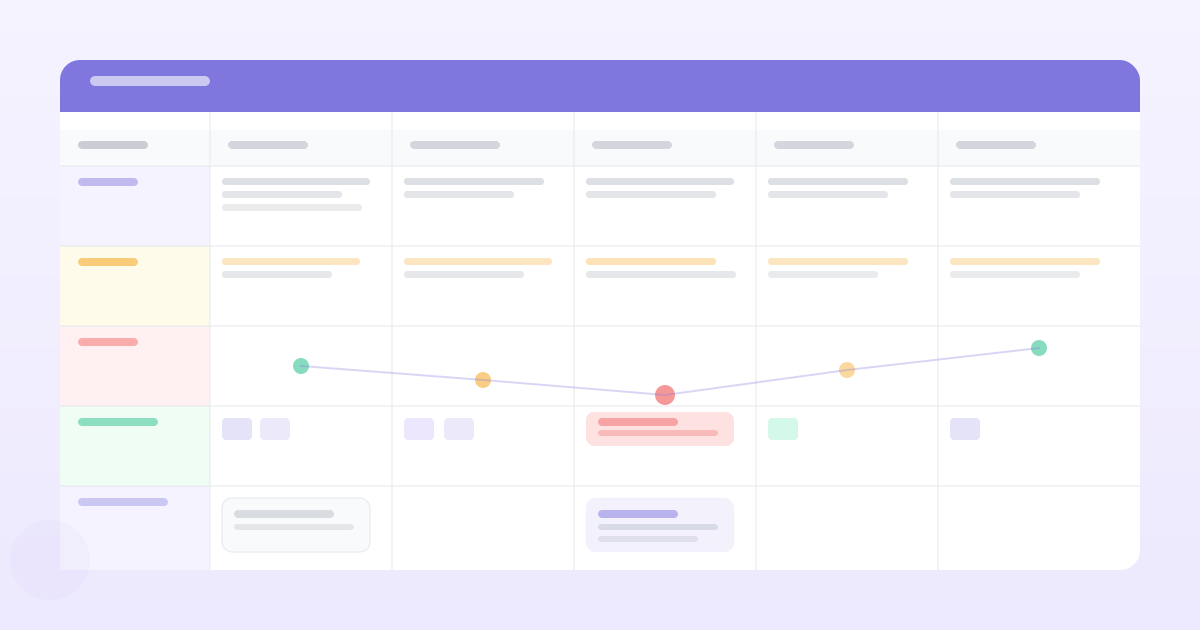
Afternoon: lay out all observations from days 2–3. Every distinct observation goes on its own sticky note or spreadsheet row. Cluster by theme. Count frequency: how many of 8 interviews mentioned each theme?
You're looking for signals that are both frequent (mentioned by 5+ of 8 users) and acute (the user expressed frustration, described significant workaround effort, or rated it as a primary concern).
One highly acute problem that only one user mentioned is not a discovery sprint finding. One mildly inconvenient thing mentioned by all 8 users probably isn't worth a major feature investment either. The combination of frequency and acuity is what drives the decision.
Day 4: Deepen on the strongest signals
Pick the two or three themes with the highest frequency and acuity. Conduct two more targeted interviews — you can often do these more efficiently now that you know what you're looking for.
These day-4 interviews test your initial synthesis. "We noticed in earlier conversations that users feel X. Has that been true in your experience?" You're not leading witnesses — you're confirming whether a pattern you identified is real or an artifact of your initial sample.
Day 4 is also where you research the status quo: what are the actual workarounds people use? Screenshot them. Map them. The detail of existing workarounds tells you exactly what a solution needs to replace.
Day 5: Synthesis and decision
Write up findings in the format that will actually be used:
Finding: 7 of 10 users in the discovery sprint had no mechanism for knowing when new insights were added to their project after they'd already been in the tool that day. They relied on weekly sprint planning as their only re-engagement trigger.
Evidence: Three direct quotes, the most specific first.
Implication: A push notification or digest mechanism could increase return visit frequency without adding noise. The threshold is weekly, not daily — multiple users mentioned daily notifications as excessive.
Decision: Proceed to solution exploration / shelve for later / need more research on X before deciding.
The output is not a feature list. It's a recommendation, with reasoning, grounded in specific observations from real customers.
Common Discovery Sprint Mistakes
Recruiting the wrong people. Your most loyal users will validate the product you have. For discovery, you want users who are struggling — with your product or with the problem category before they've found your product.
Asking about solutions too early. "Would you use a weekly email digest?" is a solution question. Ask it only after you've thoroughly understood the problem. If you ask it in the first 10 minutes of an interview, the answer is almost always yes, and it tells you nothing.
Synthesis by committee. If you have 6 people doing synthesis, you'll end up with 6 different interpretations of what you heard. One person should own the synthesis and bring conclusions to the group for challenge — not build conclusions by committee.
Treating one sprint as sufficient. A discovery sprint answers the question you asked. It doesn't answer every question about the problem space. If the sprint surfaces new questions, you may need a follow-up sprint or a more targeted set of interviews.
When to Run a Discovery Sprint
A product discovery sprint is most useful:
- Before committing engineering resources to a major new area
- When there's significant internal disagreement about what users actually want
- When retention is declining and you don't know why
- When you're entering a new segment and have limited existing customer insight
It's probably not necessary for small iterative improvements to an existing feature where you have good usage data and recent qualitative feedback.
PMRead can help you extract and frequency-rank insights from your interview recordings and transcripts — turning the synthesis step of a discovery sprint from a half-day manual exercise into something you can review in 20 minutes.
Want PRDs grounded in your actual customer data?
PMRead ingests your interviews, Slack threads, and feedback files — and generates PRDs backed by real evidence, not guesses.
Try PMRead free →